News & Events
From innovative non-space Earth Observation to resilient decisions: climate, hazards and water-land services – CiROCCO and DEAL Cluster projects at the 2026 GEO Symposium
On 26 May 2026, CiROCCO contributed to the 2026 GEO Symposium & GEO-21 Plenary through a collaborative DEAL Cluster presentation titled “From innovative non-space Earth Observation to resilient decisions: climate, hazards and water-land services.” The presentation was delivered by Eleni Athanasopoulou, Research Fellow at the National Observatory of Athens (NOA), on behalf of four DEAL Cluster projects: CiROCCO, UAWOS, TEMBO Africa and EULIAA.
The session brought together complementary perspectives on the role of innovative, ground-based and non-space Earth Observation infrastructures in addressing persistent observation gaps, particularly in under-sampled, remote and environmentally challenging regions. By combining experiences from hydrological monitoring, desert and dust observation, upper-atmosphere lidar systems and cost-effective environmental sensing networks, the presentation highlighted how Europe-funded projects can collectively contribute to more resilient environmental decision-making.
The presentation opened with a key question: why does community matter? In the context of GEO, Copernicus and the wider Earth Observation ecosystem, the answer lies in the need to address spatio-temporal gaps in environmental data. While satellite observations provide broad coverage, many vulnerable environments still require reliable in-situ measurements for calibration, validation, long-term monitoring and operational use. The projects presented through the DEAL Cluster focus precisely on these gaps, showing how non-space EO infrastructures can support scientific understanding, operational services and policy-relevant applications.
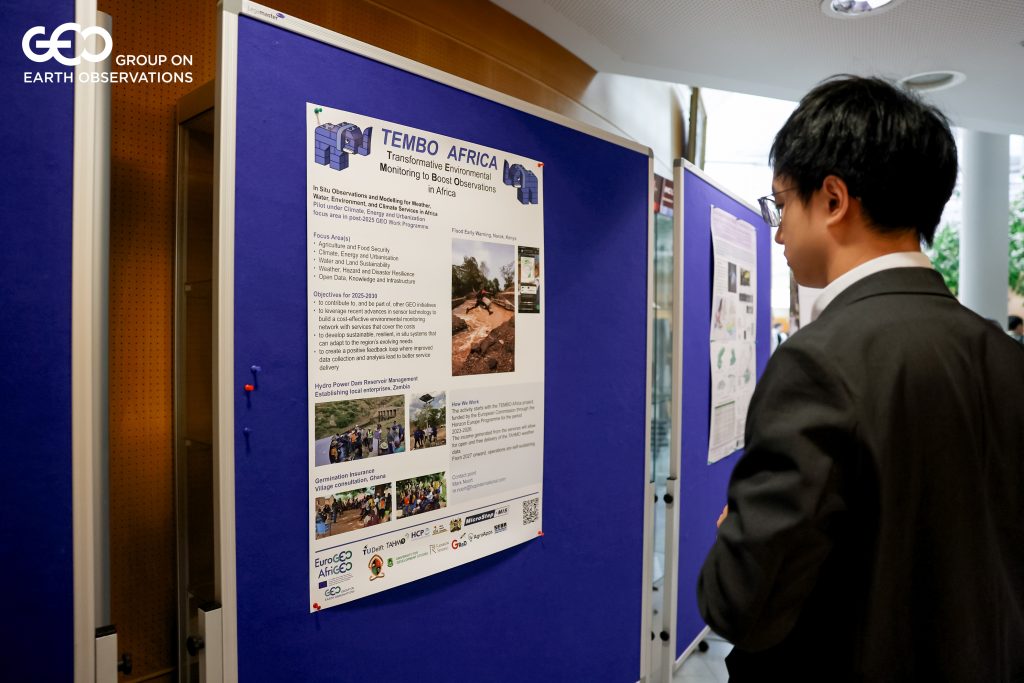
Each project contributed a distinct pathway from Earth Intelligence to resilient decisions. UAWOS presented open datasets supporting water and land sustainability through high-resolution, drone-based environmental observations. EULIAA introduced compact, autonomous, eye-safe UV lidars for ground-based monitoring of the upper atmosphere, with field deployment stories from Norway and France. TEMBO Africa demonstrated an EO-to-benefit approach focused on hazard resilience through cost-effective environmental monitoring systems CiROCCO highlighted the value of research-private sector collaboration in the co-development and manufacturing of atmospheric measurement systems for harsh environments.
Across the four projects, several common messages emerged. First, innovative non-space EO infrastructures are being developed to reinforce the in-situ component and close critical observational gaps. These infrastructures generate open datasets, operational services and scalable monitoring systems that are relevant to GEO and Copernicus activities. Second, the projects rely on partnerships with operational agencies, end-users and public-sector actors, accelerating the translation of research outputs into decision-making contexts. Third, they face similar deployment
challenges, including energy autonomy, infrastructure limitations, harsh environmental conditions, connectivity, remote management and long-term maintenance.
As the CiROCCO representative noted during the presentation, “Despite operating across very different environments – from alpine and tropical regions to hydrological and desert applications – the projects converged around common technical challenges and solutions: energy autonomy, low-cost sensing, multi-connectivity, remote management.”
For UAWOS, the value of integration was central: “By integrating EO and in-situ data, open and scalable UAV-based hydrological observations can turn fragmented water information into actionable intelligence for monitoring, management and climate resilience.”
EULIAA emphasized that autonomy cannot be treated as an afterthought, stating that “Autonomy must be designed with regulation and site reality — not added afterward.”
TEMBO Africa, meanwhile, underlined the transformative potential of affordable sensing technologies: “Advances in electronic sensing enable leapfrogging in environmental monitoring by making dense, cost-effective observation networks feasible in data-scarce regions.”
The presentation also reflected on the alignment of the DEAL Cluster projects with the GEO In-Situ Strategy. Shared expected outcomes include low-cost and scalable monitoring, high spatial coverage, QA/QC, connectivity, autonomy and robustness; new open environmental datasets from rivers, the upper atmosphere, desert regions and monitoring sites across Kenya and beyond; and practical knowledge-sharing with area managers, local decision makers, customers and local investors.
For CiROCCO, this joint presentation was an opportunity to showcase how its work on low-cost sensing nodes, high-quality monitoring stations, portable sunphotometers, data fusion and modelling contributes to a wider movement towards operational, sustainable and transferable in-situ Earth Observation. Within the DEAL Cluster, CiROCCO’s experience in under-sampled desert and desert-adjacent environments complements the work of projects addressing hydrological systems, atmospheric profiling and environmental monitoring in data-scarce regions.
Through this collaborative contribution, the DEAL Cluster reaffirmed the importance of working across projects, disciplines and geographies. The shared message was clear: resilient decisions require more than isolated data streams. They require interoperable, locally maintainable, scalable and trusted observation systems that connect Earth Observation technologies with the real-world needs of communities, authorities and environmental managers.